 Go back
Louise Harris
Electronic and audiovisual composerLouise Harris is an electronic and audiovisual composer. She is also Lecturer in Sonic and Audiovisual Practices at The University of Glasgow.
Louise specialises in the creation and exploration of audiovisual relationships utilising electronic music and computer-generated visual environments, and her work encompasses fixed media, live performance and large-scale installation formats. Louise’s work has been performed and exhibited nationally and internationally, including at the AV Festival, Newcastle (2010), International Computer Music Conference (ICMC), Huddersfield, UK (2011), Naisa SOUNDplay festival, Toronto, Canada (2011, 2015), Strasbourg Museum of Modern Art, Strasbourg, France (2012, 2013, 2014), Piksel Festival, Bergen, Norway (2012, 2013, 2014), Linux Audio Conference (2013, 2014, 2017), Sonorities Festival, Belfast, UK (2014, 2015, 2016), Sweet Thunder Festival, San Francisco, USA (2014) and Kiblix Festival, Maribor, Slovenia (2015).
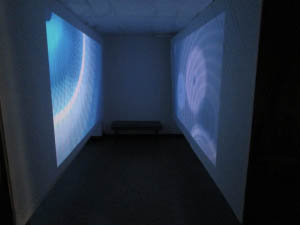
Recent commissions include 30-minute radio art works for Stazione di Topolo and RadioArts. Louise was the first female recipient of the Klingler Electroacoustic Residency in 2016, has been shortlisted for the Lumen Prize (2012) and was awarded the World Prize at the Electroacoustic Competition Musica Viva (2011). Most recently, her piece pletten was awarded first prize at the 2016 Fresh Minds Festival, and her solo exhibition, Auroculis (2017), was the first solo exhibition featured in the new Alchemy Film and Arts space in Hawick.

The project explores the intersection of audiovisual art and scientific research through three lines of investigation. It examines Expanded Audiovisual Format (EAF) as a tool for creating immersive public art experiences, using the solo exhibition Auroculis as a case study. It also explores the use of simultaneous data audiovisualisation in collaboration with epigeneticist Dr Duncan Sproul at the University of Edinburgh to identify faulty genome sequences in cancer research. Finally, it investigates how computer vision and human-computer interaction techniques can help identify and analyse audience responses to public art, through a collaboration with Dr Julie Williamson at the University of Glasgow. Together, these research trajectories highlight the potential of audiovisual art to contribute to scientific discovery and foster meaningful collaborations between art and science.