
Robotics is no longer a technology exclusive to factories, laboratories, or research centres. In recent decades, robots have also been incorporated into other fields, such as art and domestic environments.
Robotic Art encompasses artistic practices in which robotics forms part of the creative process or the artwork itself. Robots, sensors, programming, and artificial intelligence can be used to create works capable of moving, reacting to audiences, interpreting information, or developing specific behaviours.
What can a robot do within a work of art?
A robot can perform many different functions within an artistic work. It can move through a space, react to the presence of visitors, manipulate objects, draw, write, or physically modify an installation. It can also follow a set of predefined rules and produce different results depending on the data it receives.
This means that robotics does not have to be limited to carrying out a repeated action. An artist can design the conditions under which the system operates and allow its movements, reactions, or results to become part of the experience of the artwork.
In this context, elements such as programming, sensors, motors, or computer vision systems are no longer merely technical components. They become tools that artists can use to define how an artwork moves, how it responds to its surroundings, or how it interacts with people.
The incorporation of artificial intelligence expands these possibilities even further. A robotic system can interpret images, recognise specific situations, process information, or generate responses that are not entirely predetermined.
The combination of robotics and artificial intelligence therefore opens up new possibilities for artistic creation: artworks that react to their surroundings, installations that modify their behaviour, or systems capable of generating different outcomes based on the information they receive.
Robotic Art at Technarte
Robotics has been present in different editions of Technarte through projects that explore its possibilities within artistic creation. Among them are the works of Lotta Stöver and Adam Wadey.
Lotta Stöver, whose work 1000 Behaviors was presented at Technarte 2022, created an experimental framework for observing and developing different behaviours in a robot. The work consists of nine segments driven by servomotors and connected by joints. Based on generated and processed data, the system produces different movement patterns, exploring how a robotic system can evolve towards different forms of mobility.

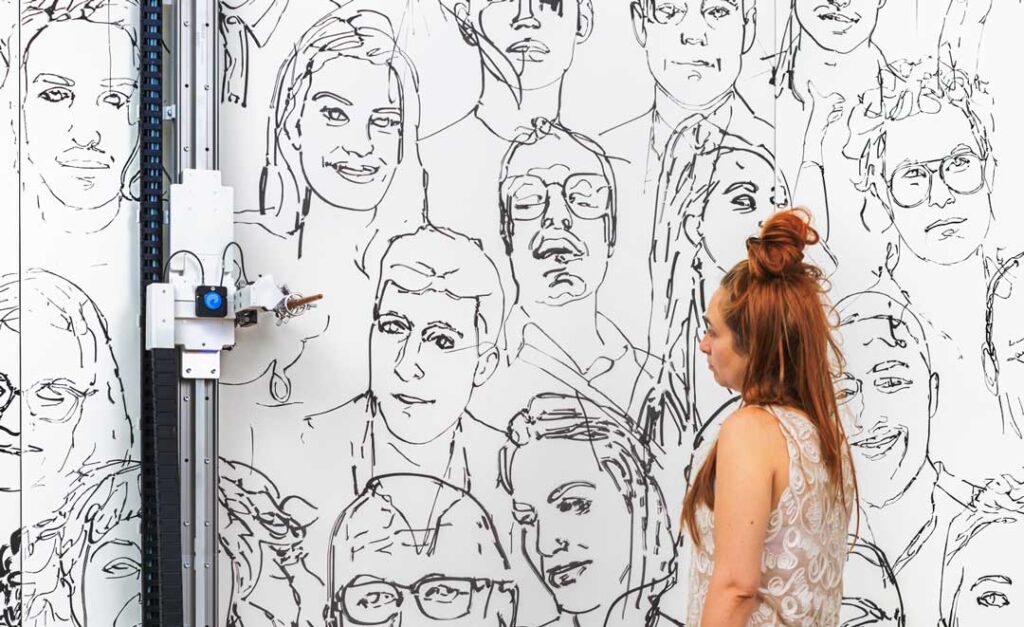
At Technarte 2026, Adam Wadey presented Faces Of…, a work that combines artificial intelligence and robotics to create portraits of visitors. The installation begins with a blank canvas and, as people enter the space, a robotic mechanism equipped with an ink brush paints their portraits onto the canvas. In this way, visitors are progressively incorporated into the artwork, creating a composition that represents the community that passed through the space that day.
The Technarte 2027 Call for Papers is open to artists, researchers, scientists, and creators working at the intersection of art and technology. The call seeks proposals that explore new forms of creation and establish innovative relationships between disciplines, tools, and technological processes.
Projects do not need to be linked to a specific technology. They may address areas such as AI Art, Generative Art, Data Art, Robotic Art, Interactive Architecture, Bioart, New Media Art, or Human-Computer Interaction, among other approaches to contemporary creation.
The deadline for submissions is 15 October 2026. Proposals must be submitted in English and, at this initial stage, only a project abstract is required.
Recent Comments